Tuesday, April 26, 2022

Speculative Fiction: Is Science Fiction Inherently Humanistic?


Science fiction. A genre in which I freely admit it is difficult to find quality works that are not totally incompatible with Christianity. In fact, it's super easy to rank in Amazon's top 100 Teen and Young Adult Christian Science Fiction category. But does that mean it's all bad and must inevitably turn readers away from God?

What I found in my research is that many object to science fiction on the basis that it promotes humanistic ideals and elevates both man and science to the level of God, thus replacing Him. Science fiction is often based upon Darwinism, excludes God from the narrative, promotes the idea that our salvation rests in the technology and inventions of man, and encourages moral relativism, as well as building its pseudoscience upon ideas easily disproven by true and commonly accepted science—some prominent examples of such an attitude being the works of Arthur C. Clarke and certain episodes of Star Trek: The Next Generation (Laughlin, Manlove).

Yet a predisposition towards humanism is not a necessity in science fiction: “Typically, science fiction and faith are circles that don’t intersect. In the instances when they do meet, however, it is usually one throwing stones at the other . . . . Bradbury’s stories weren’t like that, though. He wasn’t afraid to revere the Bible in his seminal work Fahrenheit 451, or to allegorize man’s search for a savior (whether on this planet or the next) in short stories like The Man. Rather than despising faith, he often embraced it, and sometimes—horror of horrors—even glorified it” (Nietz).

Furthermore, there is nothing inherently wrong with pseudoscience. Sure, hard sci-fi readers won't appreciate it, but if you're writing pseudosciencey stuff, are they really your readers? Pseudoscience and technobabble are plot devices and elements of worldbuilding, just like magic can be. They're ways to tell stories. They're methods by which to explore themes. They're a manner in which writers warn people about future dangers of many kinds. Is it evil to use FTL travel in your book when it will probably never actually exist? Will it damage people's faith to write about time travel? I certainly don't think so. They're stories and stories that can be used for amazing purposes.

Science fiction can and has been used to explore faith rather than to elevate humans above God. It is a creative way to explore creation and an apt genre for exploring the dangers of technological and social ills. For instance, Jill Williamson’s Safe Lands trilogy explores the vices of ancient Babylon in a futuristic setting, speculating about the evils Christians would face when trapped in a city ravaged by STDs and filled with debauchery, forced to reproduce to maintain the population because they are the only ones uninfected. Kathy Tyers’s Firebird series takes a different path by imagining what would have happened had humans gone to space prior to the arrival of the Messiah. 

These writers may be few and far between, but truly, science fiction can explore themes of faith, God, ethics, humanity, the dangers of trying to play God, and much more. It does not have to promote anti-Christian ideals and can indeed do quite the opposite.

Besides, sciencey things and pseudosciencey things are fun and cool and just one of many ways to use our God-given imaginations.

Speculative Fiction: Suppose There Was a World...

References

Laughlin, David. “Science Fiction: A Biblical Perspective.” Answers in Genesis, Answers In Genesis, 1 Aug. 2001, https://answersingenesis.org/culture/science-fiction-a-biblical-perspective/. Accessed 30 Sept. 2021.

Manlove, Colin N. Christian Fantasy from 1200 to the Present. Macmillan, 1992.

Nietz, Kerry. “What I Learned From Ray Bradbury.” Enclave Publishing, 9 June 2012, https://www.enclavepublishing.com/what-i-learned-from-ray-bradbury/. Accessed 30 Sept. 2021.

Monday, April 11, 2022

Speculative Fiction: Real or Not Real?


"In the quiet that follows, I try to imagine not being able to tell illusion from reality. Not knowing if Prim or my mother loved me. If Snow was my enemy. If the person across the heater saved or sacrificed me. With very little effort, my life rapidly morphs into a nightmare."

 —Mockingjay, Suzanne Collins


Upon one occasion, I spoke with a library patron regarding her concern with allowing her upper elementary-aged son to read Percy Jackson. She was worried that it would cause her son to believe in mythology, thus causing problems with his Christian upbringing. I assured her that he was more than capable of understanding that Percy Jackson and Greek mythology is fiction, and she can simply tell him that it is imaginary. Children understand.

As I researched objections to Harry Potter as a part of my English paper, I came to see that this is not an uncommon concern. Parents are afraid their children are unable to distinguish between fantasy and reality.

While in the early 20th century it was believed that children as old as preteens “struggle with this confusion” between reality and imagination, more recent studies indicate that children as young as three have a good sense of what is real and what isn’t (Taub and Sevarty, 57-62). There certainly may be children who have difficulties distinguishing fantasy from reality, but in most cases, a simple statement from a trusted adult that a particular thing is not real or is imaginary is enough to set the child straight. 

Truly, the only situation in which I can ever remember being confused as to the difference between fiction and reality was Little House. It's a fictionalized account of real people and events, and in any such based-on-a-true-story book or movie it is difficult to discern what is real and what isn't without thorough knowledge of the true events. But I never believed Oz was a real place, or that I could get to Narnia, or that I could tesser across the universe. I never thought I was really in an Annie-like orphanage, or that I lived on the frontier, or that my Barbies were sentient, whether they were running for public office or trekking to Oregon in covered wagons. Nor have I ever interacted with a child—either as a child myself or while babysitting—who appeared to believe their imaginings were real either. In fact, when playing we lived during the American Revolution with a battle raging outside with some friends, one little girl, under five at the time, appeared to be genuinely scared. Slightly worried about it, I asked her if she was really scared or just pretending. She instantly snapped out of it, said "just pretending," then went back to acting terrified.

Imagination is a wonderful thing. Yet some people simply don't see it as such. In fact, there are people who—apparently discounting the creative ability of children—believe that imaginary friends are actually demonic in origin. I had imaginary friends as a two-year-old (I credit Barney with the early development of my imagination; I read in a book once that children don't typically have imaginary friends until they are a year or two older). My sister and real-life friends have had imaginary friends and imaginary adventures. I still in a way have imaginary friends. They're called fictional characters. But I'm fairly certain none of us ever believed that the things we pretended were reality.

Certainly there are mental conditions that can cause people to believe things exist that are not real, but that is not the average child, and not the average speculative fiction reader. I may have enjoyed playing Jedi Temple training, having lightsaber battles, pretending to go on rescue missions chasing down bounty hunters, and wishing there was a live-action series based on Jedi Quest wherein I played Darra Thel-Tanis, but I never once actually thought Jedi were real or that I could use the Force.

So this is as much to say, parents may very well be concerned about their child's ability to distinguish fantasy from reality, but I believe that except in rare cases, they need not worry. And this concern from parents is simply a perfect opportunity to discuss literature and truth and philosophy and much more with their children, something that is beneficial to the building of a worldview regardless of the strength of the child’s grasp on reality and rather increases the benefits gained from speculative fiction.


Reference

Taub, Deborah J, and Heather L Servaty. “Controversial Content in Children's Literature: Is Harry Potter Harmful to Children?” Harry Potter's World: Multidisciplinary Critical Perspectives, edited by Elizabeth Heilman, RoutledgeFalmer, 2003, pp. 54–57.

Monday, March 28, 2022

Speculative Fiction: The Matter of Mythology


Confession: I have never been a big fan of mythology. I've just always thought it was kind of dumb. People really believed in those stories? How is that possible?

But I still read Greek myths, and I never batted an eye at the mythological creatures that inhabit Narnia. Furthermore, I very much enjoyed the Percy Jackson series, and was super excited when the official greenlight on the Disney+ adaptation was announced.

I do see why someone would be concerned about the inclusion of elements of mythology: mythology is inherently anti-biblical, presenting a view of the world that is based upon false gods and imaginary spirituality. Some have asserted that such use of mythology—particularly in Christian stories such as The Chronicles of Narnia—distorts the truth and causes readers to become dangerously comfortable with alternate worldviews and religions, that even Christ-figures such as Aslan are problematic and draw readers away from the truth (Kjos). 

Certainly stories that assert as their premise that mythology and false gods are real—the Percy Jackson series by Rick Riordan, for example—could be challenging for young readers and readers with little discernment, though I would suggest that mature, discerning readers can enjoy these tales simply as entertaining fiction. Yet it is possible to include mythological creatures and even gods in a way that is not inconsistent with Christianity. 

In Narnia, for instance, fauns, centaurs, dryads, and even Bacchus and Silenus are created beings subject to Aslan just as much as the Talking Beasts are—simply a part of the worldbuilding. Indeed, leading children astray by familiarizing them with myths and setting up false pictures of Christ was not Lewis’s intention, nor is it the intention of any writers of Christian fantasy I have encountered. Rather, Lewis’s intention was to enhance rather than destroy children’s faith as is evident from the letter he wrote to the mother of Lawrence Krieg. 

Lawrence was concerned that he was “loving Aslan more than Jesus” but Lewis asserted that “the things he loves Aslan for doing and saying are simply the things Jesus really did and said. So that when Lawrence thinks he is loving Aslan, he is really loving Jesus: and perhaps loving Him more than he ever did before” and then suggested a prayer for Lawrence to pray that further exemplifies this intention (C. S. Lewis Letters to Children, 52-53). Like magic, mythology and symbolism must be used wisely and with caveats, not elevating these mythological figures to a status that replaces God, but within a proper framework, it too can be a powerful storytelling and worldbuilding tool even in Christian speculative fiction.

Besides, even though mythology was created as an alternative explanation for the universe, the stories and creatures are often highly creative and perfectly useful to fantasy writers. Certainly, deep worldbuilders may look down on you for not inventing something entirely new, but there is nothing new under the sun and I see no less reason to incorporate fauns and centaurs into your worldbuilding than elves. Though one must naturally take care to put one's own twist on things. While straight-up copying out of copyright things may not technically be illegal, it's still lazy. And there's so much that can be done with mythological creatures and tales.

Speculative Fiction: Real or Not Real?

References

Kjos, Berit. “Narnia Part 1: Blending Truth and Myth.” Crossroad, Kjos Ministries, Dec. 2005, http://www.crossroad.to/articles2/05/narnia.htm. Accessed 1 Oct. 2021.

Kjos, Berit. “Narnia Part 2: A Four-legged Creator of Many Worlds.” Crossroad, Kjos Ministries, Dec. 2005, http://www.crossroad.to/articles2/05/narnia-2.htm. Accessed 1 Oct. 2021.

Kjos, Berit. “Narnia Part 3: Christian allegory + Mythical gods = Deception.” Crossroad, Kjos Ministries, Dec. 2005, http://www.crossroad.to/articles2/05/narnia-3.htm. Accessed 1 Oct. 2021.

Kjos, Berit. “Narnia Part 4: Awakening Narnia with Bacchanalian Feasts.” Crossroad, Kjos Ministries, Dec. 2005, http://www.crossroad.to/articles2/08/caspian-4.htm. Accessed 1 Oct. 2021.

Lewis, C. S. C.S. Lewis Letters to Children. Edited by Lyle W. Dorsett and Marjorie Lamp Mead, Macmillan, 1985.

Monday, March 14, 2022

Speculative Fiction: The Question of Magic


Magic. Ah, for the most controversial aspect of fantasy.

It's understandable why people are so concerned. Witchcraft is a very real and very dangerous thing. And it has often been asserted that fantasy magic inevitably promotes witchcraft and other aspects of occultism. Most notably, the Harry Potter series has come under fire for purportedly containing “actual beliefs and practices associated with witchcraft and paganism including: divination, astrology, numerology, familiars, pagan gods/goddesses, spellcasting, potions, necromancy (i.e. communication with the dead/ghosts), mediumship/channeling, crystal gazing, palmistry, charms, arithmancy and magick” (Abanes, 173). Even some of those Christians who find Rowling’s brand of magic to be imaginary are still concerned that the positive portrayal of witchcraft and wizardry in Harry Potter will lead children into the discovery of real witchcraft and other occult practices (Greisinger). I'm not a big fan of Harry Potter for reasons I'm not going to get into here (you can read my Goodreads review if you're curious), but I'm personally not in the Harry Potter is real witchcraft camp. 

Furthermore, even books such as The Chronicles of Narnia have been accused of containing potentially harmful positive depictions of divination, astrology, and magic (Kjos). Yes, Narnia, with it's suppositional portrayal of Christ's sacrifice, with its positive impact on Christians.

I do not believe this concern should be taken lightly, and indeed there are fantasies that truly do promote occultism and witchcraft. Yet including magic in a story does not inevitably cause the book to be harmful and evil. It must be handled carefully, for the biblical prohibition of witchcraft is a serious one, but it can be handled in a way that does not violate biblical principles. 

Considering the source of the power and making it clear that purportedly good magic does not come from evil sources is essential. Supernatural power may very well originate with demons, thus constituting evil magic, but supernatural power can also originate with God, as evidenced by the biblical story of Moses versus Pharaoh’s sorcerers, and in many fantasies and science fictions, abilities that seem supernatural to humans are simply inherent abilities of fictional species. 

There is so much room for creativity, even within boundaries. Certainly, a Christian writer should never condone a protagonist using actual occultish magic for evil purposes, or indeed, using it with good intentions, for such a thing would promote end justifies the means philosophy. I would even venture to say that it's unwise to go into the details of bad guys doing actual occultish magic. But not all magic falls into real-world practices. For example, Cinderella's fairy godmother waving a wand and singing "Bibbidi-bobbidi-boo" isn't going to conjure up demonic power. Neither is Elsa's ice magic.

What I have come to love in recent years is magical/supernatural abilities that are either gifts of God (e.g. bloodvoicing in Blood of Kings) or inherent abilities of species or characters (e.g. elven magic in Elven Alliance, Merlin's magic in BBC Merlin). There's so much you can do with that as a writer, and in those cases, it's evident the characters aren't calling on demons for their power. And the interesting thing is, even with things such as that, the characters aren't always going to use it for good purposes, which can make for some interesting and powerful themes. Human nature twists even things that are meant to be good. For instance, in Blood of Kings, bloodvoicing is an ability given by Arman to those of royal blood, and some use it to fight for good, some to enact evil. It's the same thing in Merlin. Merlin tries to use his magic for good (and when he uses it for selfish or stupid reasons, it always ends badly), but there are also lots of bad guys using magic to try to kill Arthur and/or Uther. Therefore, it is not even necessary to have bad guys calling on demonic power to create magic-related conflict. After all, evil is in the hearts of men, not necessarily the tools they are using. People have even twisted Scripture to justify and promote various forms of abuse.

Additionally, as Lewis and Tolkien did, confining good magic to entirely imaginary sorts used in other worlds by characters who are not the protagonists is a potential way to handle magic well. This article was foundational in my formation of my beliefs surrounding fantasy magic and, though long, is well worth the read. Used thoughtfully with caveats, magic and superpowers need not be harmful and can add great value and potentially allegorical meaning to a story.

Though perhaps less prominent than the attacks on fantasy, science fiction has also come under fire for promoting anti-Christian ideals. It has been said that common science fiction elements such as telekinesis and telepathy are occult, New Age, Eastern Mysticism concepts masquerading under supposedly “ ‘scientific’ terms”, the Force in Star Wars being a prime example of this occultism and Eastern Mysticism brought into a futuristic setting (Laughlin). Yet it is not impossible to see unintended faith metaphors in secular fiction, as Star Wars author Kathy Tyers stated in an interview with TheForce.Net. Certainly one must approach these scenarios with caution because they tend to mix in elements that are not strictly Christian, but if one views science fiction through the lens of a biblical worldview, it is just as possible to see limited elements of Christian spirituality in the Jedi, particularly as written by authors such as Tyers, as it is to see a picture of spiritual rebirth in the regeneration of Time Lords in Doctor Who. They may be imperfect pictures, but a proper perspective can see value in these purportedly occultish and New Age science fiction elements. 

Furthermore, these sorts of plot and worldbuilding elements can be used in purposely Christian science fiction stories. Madeleine L’Engle’s A Wrinkle in Time has often been accused of promoting occultism and “New Age spirituality,” though it is full of Scripture quotations and written as a way of exploring the author’s faith through science (Bailey). She had no intention of promoting evil by including telepathic abilities and other strange elements such as tessering and kything in her stories—rather, she was writing about defeating the darkness with the light of love, and science fiction and fantasy elements provided a perfect storyworld for this message. Besides the fact that kything is just plain cool, and so is tessering.

Speculative Fiction: The Matter of Mythology

References

Abanes, Richard. Harry Potter and the Bible: The Menace behind the Magick. Horizon Books, 2001.

Bailey, Sarah P. “Publishers Rejected Her, Christians Attacked Her: The Deep Faith of ‘A Wrinkle in Time’ Author Madeleine L’Engle: Her Famous Book is Sprinkled with Scriptural References” WP Company LLC d/b/a The Washington Post, Washington, 2018. ProQuest, https://www.proquest.com/blogs-podcasts-websites/publishers-rejected-her-christians-attacked-deep/docview/2012009596/se-2?accountid=11824. Accessed 21 September 2021.

Greydanus, Steven D. “Harry Potter vs. Gandalf.” Decent Films, 2001, http://decentfilms.com/articles/magic. Accessed 31 Oct. 2021

Griesinger, Emily. “Why Read Harry Potter? J. K. Rowling and the Christian Debate.” Christian Scholar's Review, vol. 32, no. 3, 2003, pp. 297-314,314-316. ProQuest, https://www.proquest.com/scholarly-journals/why-read-harry-potter-j-k-rowling-christian/docview/201277855/se-2?accountid=11824. Accessed 21 September 2021.

Kjos, Berit. “Narnia Part 1: Blending Truth and Myth.” Crossroad, Kjos Ministries, Dec. 2005, http://www.crossroad.to/articles2/05/narnia.htm. Accessed 1 Oct. 2021.

Kjos, Berit. “Narnia Part 2: A Four-legged Creator of Many Worlds.” Crossroad, Kjos Ministries, Dec. 2005, http://www.crossroad.to/articles2/05/narnia-2.htm. Accessed 1 Oct. 2021.

Kjos, Berit. “Narnia Part 3: Christian allegory + Mythical gods = Deception.” Crossroad, Kjos Ministries, Dec. 2005, http://www.crossroad.to/articles2/05/narnia-3.htm. Accessed 1 Oct. 2021.

Kjos, Berit. “Narnia Part 4: Awakening Narnia with Bacchanalian Feasts.” Crossroad, Kjos Ministries, Dec. 2005, http://www.crossroad.to/articles2/08/caspian-4.htm. Accessed 1 Oct. 2021.

Potts, Michael, and Kathy Tyers. “Jedi Council - Interviews: Kathy Tyers.” TheForce.Net - Your Daily Dose of Star Wars, The Force.Net, Nov. 2000, http://theforce.net/jedicouncil/interview/tyers.asp. Accessed 7 Nov. 2021

Taub, Deborah J, and Heather L Servaty. “Controversial Content in Children's Literature: Is Harry Potter Harmful to Children?” Harry Potter's World: Multidisciplinary Critical Perspectives, edited by Elizabeth Heilman, RoutledgeFalmer, 2003, pp. 54–57.

Monday, February 28, 2022

Speculative Fiction: Dangerous Occultism or Witnessing Tool?


It's impossible to know me and be unaware of how much I love science fiction and fantasy. It's just a big part of what makes me me. And so it's not probably a surprise that when my English professor said we could write our research papers on pretty much anything as long as we could research it and make an argument about it, I decided to write about speculative fiction. More specifically, the role speculative fiction plays in the Christian community.

It's not really a secret that said role can be rather controversial. One need only look at Harry Potter to see that. So I set out down a rabbit hole of research on the objections to and defenses for science fiction and fantasy in the Christian community. It was a fascinating research subject, and I wanted to share the results. 

Some believe speculative fiction is occult and evil. Some believe it is a good thing that can be used for God's glory. Where do I fall? I'm sure you can guess, but go on this journey with me anyway to explore my conclusion and how I came to it.

Speculative Fiction: Dangerous Occultism or Witnessing Tool?

When I was young, I went through a phase where I struggled to understand the efficacy of prayer. I believe God is sovereign and in control, and that nothing happens that is outside of His will. So what good does it truly do to pray? As I pondered this, a passage from C. S. Lewis’s The Magician’s Nephew sprang unbidden to my mind:

“Well, I do think someone might have arranged about our meals,” said Digory.
“I’m sure Aslan would have, if you’d asked him,” said Fledge.

“Wouldn’t he know without being asked?” said Polly.

“I’ve no doubt he would,” said the Horse (still with his mouth full). “But I’ve a sort of idea he likes to be asked.”


From this I understood instantly that while God does know everything and He is sovereign, He still wants us to pray, to deepen our relationship with Him as well as our understanding that everything we have comes from Him. He wants us to ask. From that point forward, I ceased to struggle with this particular issue—all because of a few lines in a fantasy story. And this is only one example of spiritual understanding gained from speculative fiction. 

Yet some allege that these very stories and others like them which deepened my understanding of Scripture, illustrated biblical truths, and enhanced my faith are inherently harmful and evil, rather promoting such things as occultism, humanism, and witchcraft. Many of my fellow writers within the Realm Makers community have faced backlash from family and church family for writing stories of magic, dragons, aliens, and more. 

Is there merit to these accusations that these stories we write tamper with the forbidden? Or is it rather true, as others assert, that speculative fiction is the perfect vessel for spreading God’s truth and reflecting the creative aspects of His nature? I contend that while these genres of fantasy and science fiction must be handled with care and a solid grounding in Scripture as a result of certain genuine concerns, they are nevertheless effective vessels for conveying God’s truth and furthering His kingdom by exploring truth in new and imaginative ways.

Speculative Fiction: The Question of Magic

References

“Christian Science Fiction & Fantasy Explained.” Performance by Steve Laube, YouTube, Enclave Publishing, 10 Sept. 2015, https://www.youtube.com/watch?v=OelI7pD6-jQ&t=73s. Accessed 30 Sept. 2021.

Lewis, C. S. The Magician's Nephew. Scholastic Inc, 1995.

Monday, February 7, 2022

A Word About Legalism

Rules.

Check boxes.

Formulas.

Works.

The longer I live in this world, the more I see that legalism doesn't work. In fact, more often it creates even more problems.

My family didn't have a lot of rules when I was growing up. Sure, we had some:

Don't go past Hannah (next door neighbor)'s house. (Our parents wanted to be able to see us when they looked out the window.)

No dancing in the kitchen. (Um, I still turn pirouettes in the kitchen and I never got in trouble for violating the rule...I just try not to dance when there's something hot on the stove or someone's walking around with a knife.)

Read the book before watching the movie. (Mostly just applied to me, but I still generally try to abide by it because the book usually came first which means it's the original version.)

But my parents never wrote up a list of moral rules for us to follow. They never bought booklets telling them that if they just did these things they'd automatically have good children.

That isn't to say everything was permitted. That isn't to say we didn't have a moral code. That isn't to say we never got in trouble. (Looking at the chief culprit right here.)

But it was never about the things we do externally. It's about the heart. And once you get the heart right, the behavior follows. Out of the heart the mouth speaks.

I've known a number of families who are or have been legalistic, and I've watched others from afar. And it's disheartening how badly it turns out.

Girls can only wear skirts.

Filtering kids' shows through ClearPlay, or not even owning a TV.

Bible reading as punishment.

Don't do any kind of work on the Sabbath, ever, without exception.

Shunning stories that contain magic, even if they have positive, or even Christian, messages.

Refusing to celebrate traditional Christian holidays because the traditional celebration is not spelled out in the Bible, even if the reason we celebrate is.

No grace.

I don't want to get into the weeds here. I'm sure if you're reading this, you can think of plenty of legalistic rules, and maybe have been raised according to them yourself. The point here isn't what precisely the rules are. The point is...that rules aren't the point.

What I've seen in my personal experience is that those who are most legalistic are very likely to have their children walk away. Even if those children at one point seemed to be fine.

Because what I've seen is that, even back in Bible times (think of the Pharisees), those who have lists of rules are just following rules. Sometimes they seem to think that they must do x, y, and z in order for God to be pleased with them. And often—not every time, but often—I sense a holier-than-thou attitude out of these people. Like they believe God is more pleased with them because they follow more rules. And then, often, this attitude turns people away. Is a lost person likely to want to come to know Christ if His representatives act like self-righteous jerks who turn up their noses at those who don't follow the same standards?

"No one knows what we're for, only what we're against when we judge the wounded.
What if we put down our signs, crossed over the lines and loved like you did?"
—"Jesus, Friend of Sinners," Casting Crowns

"But God shows his love for us in that while we were still sinners, Christ died for us."
—Romans 5:8

It's not about rules. It's about the heart.

It's not about works. It's about grace.

It's not about making people conform. It's about showing the love of Christ.

See, we can't follow all the rules. That's the point. It's completely and totally impossible. And the more you try to follow all the rules, the more you overanalyze and beat yourself up for not measuring up, the worse it's going to get. And when you impose those impossible standards on your children, you're very likely to lose them.

Not trying to toot my own horn or plug my book, but I want to share a bit out of Acktorek: The Void, spoilers redacted, of course.

“Emma, no one iss ever worthy of God’s love and care,” he murmurs.

I slowly sit up, pulling my hands away to rest on my knees, as his hand comes to rest on my shoulder. “Were you listening to me?” He has no right to spy on me like that. But . . .

He cocks his head just slightly in a noncommittal gesture. “Emma.” Even through what I guess is a translator like Dad said, he sounds so soft and gentle. So kind. So caring. No one has ever said my name like that before. “God doess not love us because we are worthy. He doess not care for us because we have earned it. He loves us and cares for us because we are created in His image. We are all unworthy—you, me, Carla, Grace, Brian, everyone. You must not believe you are required to prove you are worthy for Him to [Spoiler]. That iss not how this works.”

“I’m not enough. I’ve never been enough for anyone, least of all God.” The words come out hoarse.

“You must cease trying.”

My forehead furrows. If he’s going to go into a stop trying and just do lecture, I’ll smack him.

He pulls me closer and looks me right in the eyes. I still can’t decide if this is okay or extremely uncomfortable, but I can’t pull away. Something in me doesn’t want to.

“I have been trying,” he says. “I am guilty of much. [Spoiler] I feel as if I will never do enough to compensate for the hand I played in all of these things. The truth iss that I will not. I cannot. However, it iss also true that I do not have to compensate for it. I do not have to carry the weight of all my mistakes because Jesus already paid for them. He hass washed away all of the blood that iss upon my hands. I am not adequate, you are not adequate, but He iss. He iss the only One who iss adequate. You were correct that He iss the only One who can [Spoiler] and deliver us from this situation. But His doing so doess not rest upon your worthiness. It doess not rest upon me recompensing my mistakes. The only thing that matters iss that Jesus iss worthy and He hass paid for all of our sins upon the cross. Surrender to Him, Emma. Allow Him to be worthy within you.”


We can't do enough to please God. Ever. That's why we need Jesus. Jesus fulfilled the law for us. He lives in us. We are not enough, but that's okay because Jesus is enough.

That's not to say that everything is permitted. That's not to say that our lives shouldn't be transformed by Christ. By their fruits you shall know them. But it's not about following a set of rules. It's not about the letter of the law. It's about loving the Lord our God with all our heart, soul, mind, and strength, and loving our neighbors as ourselves. It's about how it is no longer we who live, but Christ who lives in us.

Not rules.

But the transformative, unconditional, eternal love of Christ.

Monday, January 3, 2022

2021 in Review

It's apparently been a couple years since I actually did a year in review post. Interesting. I guess there hasn't been much in recent years that I wanted to relive, what with my dog dying in 2019 and the fiasco that was 2020. But somehow despite all the Covid stuff continuing in 2021, I actually on the whole feel good about 2021. Who knew, right?

January started off with my library branch finally, finally, FINALLY opening to the public, and though it was a gradual process that annoyed me with rules that kept me from properly doing my job the way I used to, I was SO glad to be able to interact with our patrons again. Sure, I can't really listen to audiobooks at work anymore, but I CAN help kids find the perfect book to read. I've even been able to help with programs again (now that we're DOING programs again) and it's heavenly. 

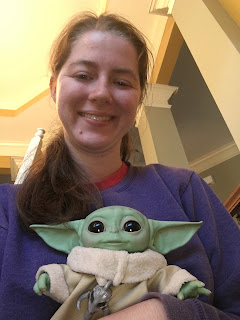
I also got myself an animatronic Grogu. 😁 Forgive the messy hair. I'm terrible at selfies, but I really don't care.


And we started planning for Realm Makers. 😁 My friends and I all stayed up to register as soon as it opened just to be sure we got spots. And it was totally worth it.

I was also spending a lot of time studying for the SAT. Which I admit was kind of nerve-wracking, but I ended up doing fine. 

Early on in the year, I tried writing the pirate book I've been wanting to write for like eight years now. I really tried. But I don't know, I guess I just wasn't in the right mindset for pirates. It's not permanently abandoned. I still very badly want that book. But what I really wanted to do was go back to Acktorek. Which is what I did. I won Camp NaNo in April, which was bittersweet because I knew it was going to be my last NaNo for awhile. (Yes, I was pretty bummed last November watching so many other people prep for NaNo knowing I had too much homework to do it myself. Someday I will do NaNo again, but that is not this day.) I really got a lot of writing done, but I still wasn't very happy with what I had. More on that later.

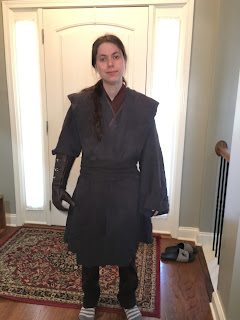
Round about this time, I was also working on Jedi costumes for Realm Makers. I dyed fabric for the first time ever, which was an adventure, and I'm pretty proud of how the costumes turned out.
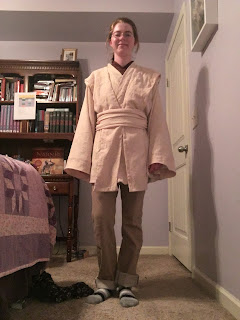
First look at Obi-Wan

First look at Anakin

Then I got accepted into Kennesaw State University and promptly went crazy with CLEPs. I studied for and passed five CLEPs in two months while also brushing up on German to make sure I could get into the class I needed. I'm still not sure how I did it. Especially since algebra and especially biology were a bear. But the English CLEPs didn't take much effort, and I got a near perfect score on the College Composition Modular test. Good thing too, since I'd told the lady at the testing center that I'm an author. I wouldn't want to talk all about my books and then turn out to be terrible at English! 😂

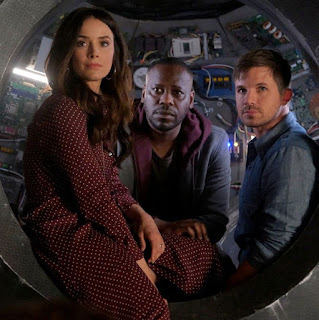
We watched Timeless early in the year, and I may have gotten slightly obsessed. Time travel+history+Matt Lanter. I mean, how could it not be fabulous?


I held a recital for my violin students and they all did a great job! They've all learned so much. I also had arranged a Return of the Jedi medley to play with my sister, which was a ton of fun.

Once Jedi costumes were declared complete, we did a photoshoot, attempting to recreate poses from the Revenge of the Sith promo materials. I normally hate photoshoots, but we had a blast with this one. And naturally I had to add lightsaber blades. See more photos here.


I went on a campus tour for part of orientation, got separated from the group when I picked the wrong time to go to the bathroom (I seem to have a knack for that) and came out to find the group had left for the dining hall without me, pulled out a book to read when the opportunities arose during the tour because that's just how I roll, understood nothing of the layout of campus because I was hopelessly turned around, and had to finish up my visit with an exploration of the campus library. I love the campus library. They have a lot of 90s Star Wars books. 😁 The first book I ever checked out from the campus library was Truce at Bakura, though all the other books I've checked out were actually for research for my English paper. And I know my way around (relevant) parts of campus now. Though I'm still not 100% sure how to get to the dining hall. Doesn't matter. I know where the Chick-fil-A is, and that's what really counts.

THEN REALM MAKERS!!! Definitely the highlight of the year. It was my first time driving on a road trip (my dad always drove on family trips) and I had very little interstate experience, so that was definitely nerve wracking. Migraine-inducing. Stomachache causing. But we managed to get there and back again and had a fabulous time while we were there, so it's all worth it. And I have a TON more interstate experience now because of my commute to school, so interstate driving and traffic don't really bother me anymore. I mean, when you have to sit for an hour in horrific traffic because of big accidents and end up late for your history midterm (I still completed it and got a 96 so it's all good), you kind of end up getting over interstate anxiety.

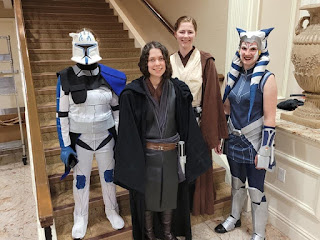
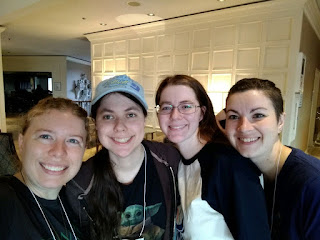
And Realm Makers was seriously amazing. Getting to hang out with Jaye L. Knight and Tricia Mingerink was awesome, and I got to meet Frank Peretti and Nadine Brandes and Sara Ella and Dave Wolverton and Carla Hoch, and I learned so many things, and our group cosplay was loads of fun, and you can find my full recap here. I don't know when I'll be able to go back, but I already can't wait. There's nothing quite like Realm Makers.
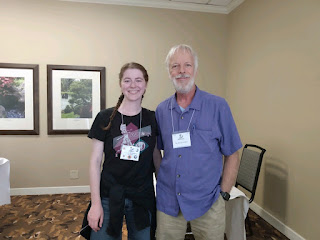
With Frank Peretti!

Rex (Tricia), Anakin (Addy), Obi-Wan (me), and Ahsoka (Jaye)

Saying goodbye is the worst

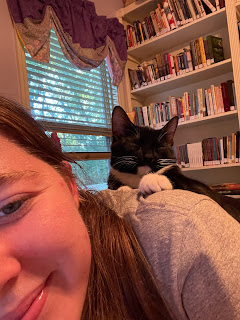
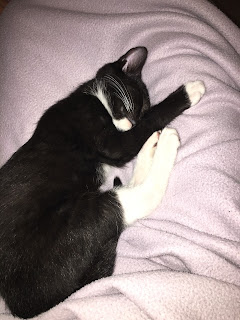
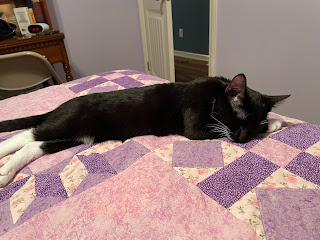
Then we got a kitten! I admit, I still prefer dogs. And no animal will ever replace my Labrador Sophie. But I do love Pippin. He's adorable, and he can be so sweet and cuddly when he wants to be. Unfortunately, he also sometimes displays a teenage attitude (he's an adolescent kitty right now, so yay). But when he's in a good mood he's just so sweet that it totally makes up for the attitude. And he loves watching TV, which is hilarious to me since Sophie couldn't care less about it. And I may have filled up my phone with cat pictures.
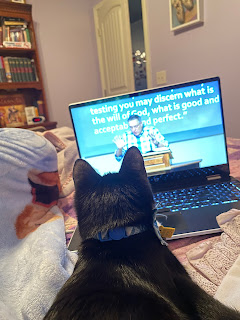

Watching church with me while sick...
I'll get to that.

One of his favorite spots


Watching Merlin with me

Then school started and it consumed my life. I mean, not totally, but mostly. Hey, I got to write my English paper on speculative fiction in the Christian community and it was great. And I loved stats too. It was a good semester, even if it was a bit of an adjustment. I did even get to the point where I was able to dabble at planning out the rest of the Acktorek series. I figured out that I needed a series plan, a general one, anyway, so that I had an actual series arc. Important stuff, knowing where you're going with a story. It was slow going, but it was going.

Aaaaand then we got Covid. It was miserable, I'll admit. But all in all, it didn't really turn out to be any worse than having the flu. Kind of interrupted my series planning, but now we've been through it. And I was still able to mostly keep up with my classes virtually. So it worked out.

Fall really was mostly school, school, and more school. And kitty cuddles. And watching Merlin while working on my paper because for some reason I couldn't focus on writing that paper without something like Merlin on in the background. Not complaining. It's my favorite show for a reason.

But then we had Thanksgiving break wherein I read three books and also discovered that LEGO Star Wars has an IOS version. Maybe a bad discovery? Anyways. We had some family over for Thanksgiving and had leftovers for days. And then back to school for a week of class and then finals. But hey, I finished my first semester of college with straight A's and with my CLEPs I'm officially a sophomore.

And I was able to take some time Christmas break to catch up on stuff. Like finishing that series plan. (Well, finish is a relative term. Parts of it are still rough and purposely so. I need room for my characters to take charge. But I have enough of a plan I think I can finally write book 2 properly. If I can find the time.) And I made the theory pages I need for my students AND finished the bulk of photoshopping on a new picture book I'd put on hold since like May. Not sure when it'll be done done since it still needs a cover and a title and to go through the whole proofing process (and school starts up again in a week), but it's significant progress.

I participated in my church's Christmas program, singing in the choir and playing violin, and it was great. I may have been quietly singing the alto part of "O Come, O Come Emmanuel" while shelving at the library. A lot. And I played the conductor for my library's Polar Express program.

And my sister and I saw Spider-Man: No Way Home opening weekend. I loved it so much! And I REALLY want to see it again. It was SO GOOD.

We had Christmas at home with colds (yippee), and I got Star Wars books and watched The Fellowship of the Ring, so it's all good. Then I got a new computer because my old one had a crack that was popping out the corner of the screen. 😜 Still not thrilled about that since all I thought I needed was a new battery, but I'd rather not have my computer totally break in the middle of the semester. We then rang in the new year with more Lord of the Rings, and it's 2022 now!

Who knows what kind of year it'll be? I know for me it'll be filled with lots more school, and hopefully some writing, but beyond that, just about anything could happen. I guess we'll just have to wait and see!